

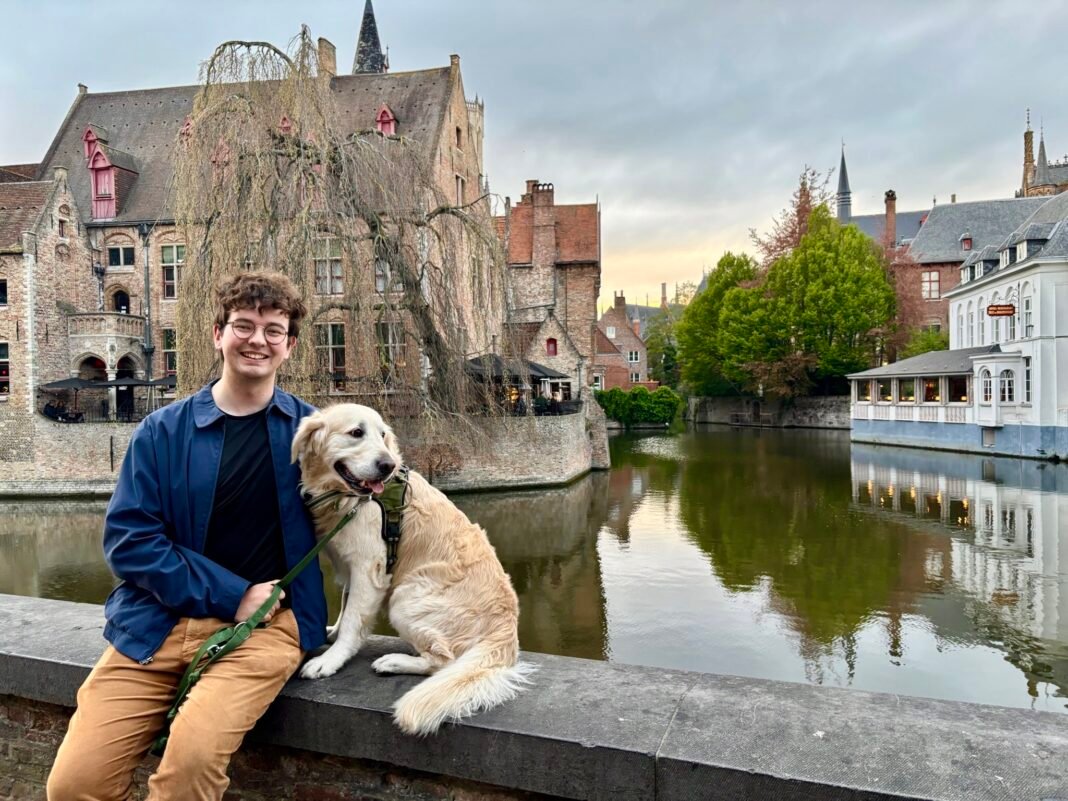
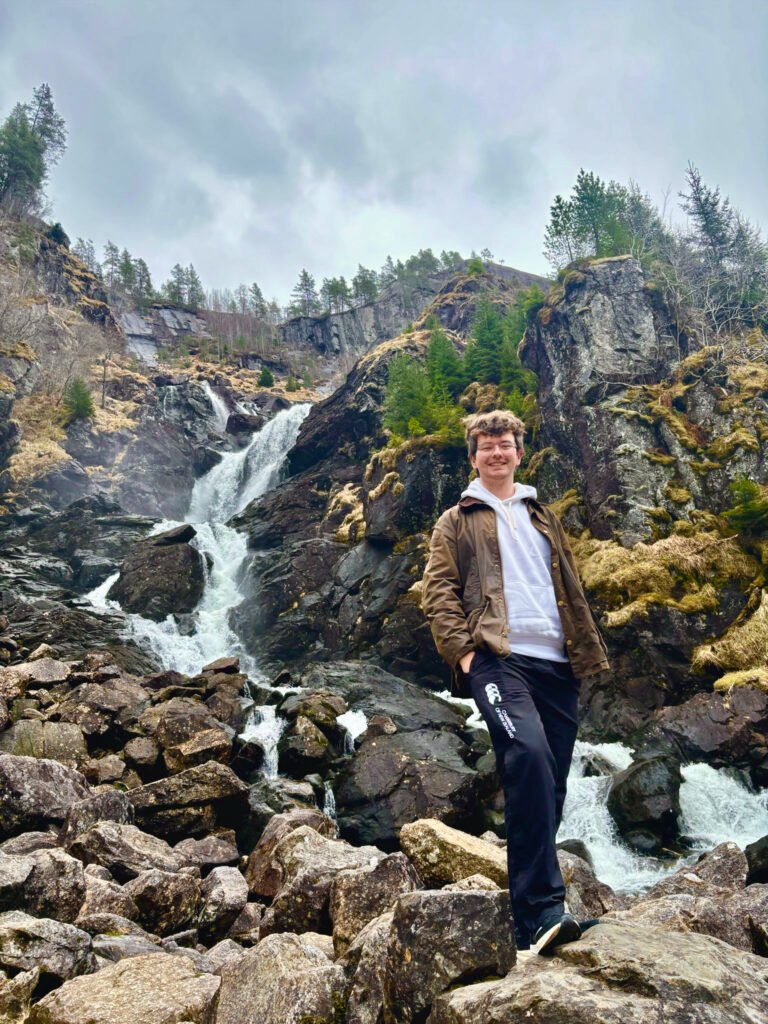
Two weeks on the road with my golden retriever, Fionn, in the boot provides plenty of time to think about Church matters. On Easter Sunday — after singing for Saint Patrick’s Cathedral’s Festal Eucharist and Choral Evensong — I set out on a journey: through Great Britain, across to France, on through Belgium and Germany, up into Denmark, and then north into Norway. Not a straight line! Most people would fly; most airlines don’t allow dogs. There were ferries to catch, roads to miss, towns discovered by accident rather than design. We stopped often. We retraced our steps more than once. Only gradually did the road draw us northwards, through the length of Norway, until at last we reached Trondheim and High Mass at Nidaros Cathedral. And then, almost immediately, we turned and began the long journey home.
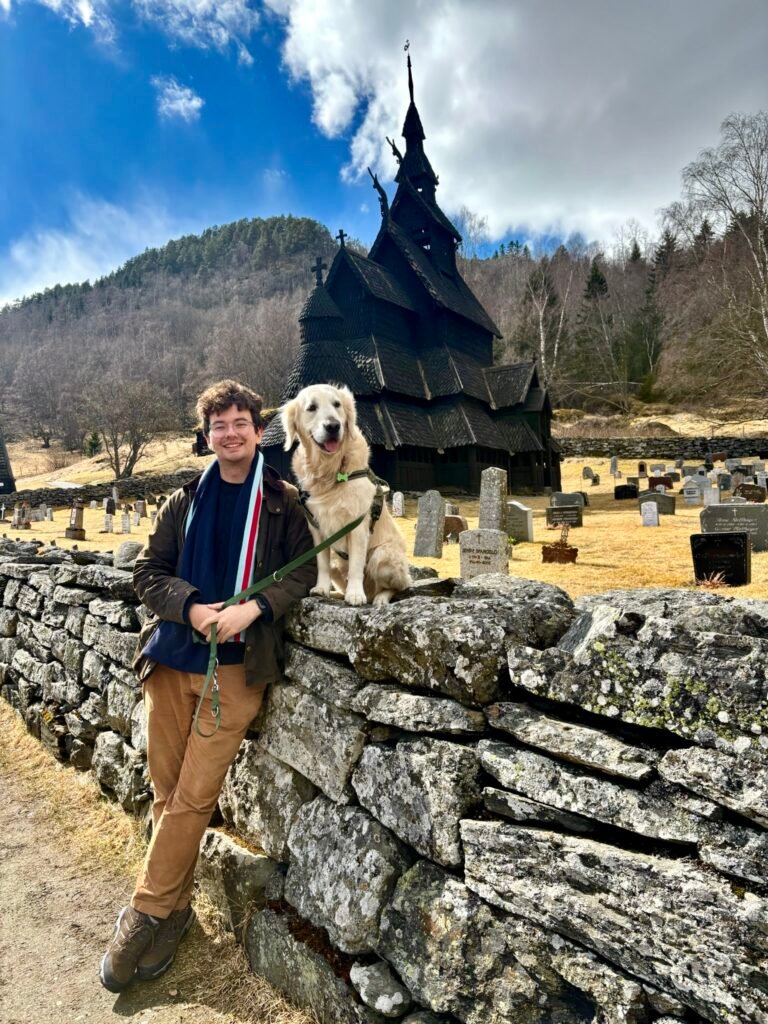
That sense of movement — of travelling, stopping, and only slowly arriving — became the real shape of the pilgrimage. Because what unfolded along the way was an insight into the life of the Porvoo Communion. The Porvoo Communion is a formal agreement of full communion between the Anglican churches of Britain and Ireland (including the Church of Ireland and the Church of England) and a number of Lutheran churches in Northern Europe and the Baltics, established in 1996 following the signing of the Porvoo Declaration in Porvoo. It recognises a shared apostolic faith, the validity of each other’s ordained ministries, and allows for mutual participation in the sacraments and interchangeability of clergy, expressing a visible unity whilst respecting the distinct identities and traditions of the participating Churches.
Throughout the journey, we called into various churches. Some were beautiful Norwegian stave churches, famed for their gothic appearance. The same essentials happened at each: Scripture was read; the Eucharist was celebrated; the structure of the liturgy was the same — even when the language was not. One did not need to understand every word to know where one was because it became familiar over time. It occurred to me that this runs deeper than merely language or custom. By the time we reached Nidaros, it felt as though we had been led, step by step, into something already known.
There is, perhaps, an echo here of the Easter story. The risen Christ is not recognised all at once. On the road to Emmaus, recognition comes slowly: in conversation, in shared company, in the breaking of bread. What had been hidden becomes clear. So it was on the long road north.
This is what the Porvoo Communion looks like in practice. It is easy to speak of agreements and mutual recognition of ministries. That is real and necessary. But its meaning is grasped most clearly in the lived experience of worship. It is the discovery that the Church’s life holds across distance and difference.
For the Church of Ireland, we are part of that communion. Our life is already interwoven with Churches whose histories and theological emphases are not identical to our own. Yet we recognise one another fully as part of the one Church, grounded in Scripture and Sacrament.
For me, that same pattern has been visible, in a different context, much closer to home. Through the Christian Theology and Practice course at the Church of Ireland Theological Institute, I have found myself in a community that reflects something of that breadth. People arrive with different instincts, assumptions, and ways of ‘doing Church’. These differences emerge in discussion, sometimes quite sharply. There are moments when it is clear that agreement will not come easily. Yet the work does not stop. We continue to learn together, to pray together, and, at times, to disagree. Formation for ministry takes place within that reality. It is not about assembling a group of the like-minded, but about being shaped within the Church as it actually is.
This begins to illuminate what communion requires. It depends on a commitment to remain: to stay in conversation, to listen with care, to resist the temptation to reduce one another to positions or labels.
This is a relevant question for the Church of Ireland at present. Tensions associated with the Anglican Communion have made underlying differences on this island more visible. These are serious matters, touching on authority, identity, and the interpretation of Scripture. They cannot be dismissed lightly. But neither can the manner in which they are handled. That, too, will shape the Church.
General Synod meets this month. It will do what Synod does: debate, refine, decide. There will be moments of clarity, and moments where clarity remains elusive. Some contributions will be measured; others more direct. That is part of the Church’s life. But Synod reveals something of who we are in the process of reaching these conclusions.
A Church may arrive at a position and yet find that something of its common life has been diminished along the way. The habits we bring to disagreement are part of our witness.
Easter speaks directly into that. The risen Christ does not return to a Church that has resolved its differences. He comes to a community marked by confusion, failure, and hesitation. Into that setting, he speaks peace.
This changes the ground on which the Church stands. Unity depends on the presence of Christ, and on the willingness of his people to remain with one another in that presence.
The Porvoo Communion offers a lived expression of that truth. These are Churches that have chosen to recognise one another fully, despite real differences. That choice shapes how they — we — live, and it establishes a discipline: communion is not set aside lightly.
The challenge is whether that same understanding can be lived within our own lives. It is one thing to affirm communion with Churches across Europe. It is another to practise it within our own parishes, dioceses, and synods, where differences are closer and often more testing. Yet if communion is to mean anything, it must be found there.
It requires a willingness to remain in good faith when conversation becomes difficult, to continue to pray together when agreement is partial, and to recognise that no single perspective exhausts the truth the Church is called to tell.
By the time I left Trondheim and began the journey south, nothing in the landscape had changed. The fjords were the same. The roads still wound and turned, sometimes frustratingly slowly. And yet the journey felt different. What had been unfamiliar now carried a sense of recognition.
There is something of that in the Church’s life. The questions we face do not disappear. The road does not suddenly become straight. There are still turns to navigate and uncertainties to face. But they can be held differently when seen within a wider horizon.
Easter does not remove the road. It does not resolve every question before us. It does something both simpler and more demanding: it gives us hope to continue because Christ goes ahead of his people.
Two weeks on the road, and years spent in the company of those who see things differently, point in the same direction. Communion is part of the Church’s given life. To remain within it — especially when it is tested — is demanding work. It is also work shaped by Easter: trusting that, even where there are real differences, the risen life of Christ is already at work, drawing his Church forward.
O God, make the door of this house wide enough to receive all who need human love and fellowship, and narrow enough to shut out all envy, pride, and strife. Make its threshold smooth enough to be no stumbling-block to children, nor to straying feet, but rugged enough to turn back the tempter’s power. O God, make the door of this house a gateway to thine eternal kingdom. Amen.
I really enjoyed the account of your trip to Norway. We were there about ten years ago and did a week’s trip on a ferry, Starting from Tromso, went up the west coast, across the top of the country to the Russian border—and then back again! There were probably about 20 stops, delivering people, goods, bicycles and so on. I attach a couple of photos .
Randal H.
PS. Photo won’t attach! If you let me have an ‘ordinary’ email address, I can send them if you are interested